Should You Offer a Discount on the First SMS Reminder?
Most store owners are sabotaging their own profits by throwing discounts at customers too early.
I know what you're thinking. "But discounts work! My recovery rate jumps every time I offer 10% off!" And you're right—they do work. The question isn't whether discounts are effective. It's whether they're necessary on that very first SMS reminder.
Stores that hold back on immediate discounts often outperform those that don't. Not always, but often enough that it's worth questioning the conventional wisdom.
The Psychology of That First Text
When someone abandons their cart, they're not necessarily saying "no" to your product. They might be:
Comparing prices across different stores
Waiting for payday
Distracted by a phone call or crying baby
Testing to see if you'll send them a discount (yes, this is becoming more common)
That first SMS reminder serves a simple purpose: "Hey, you forgot something." It's a gentle nudge, not a negotiation ... yet.
When you lead with a discount in that initial message, you're making an assumption—that price was the barrier. But what if it wasn't? What if they simply got distracted and fully intended to complete the purchase?
Now you've just trained them to expect discounts which can come back to bite you if they're a repeat shopper.
When a First-Message Discount Makes Sense
I'm not saying you should never offer a discount in your first SMS. There are scenarios where it absolutely makes sense:
High price point, high consideration purchases. If you're selling $2,000 mattresses, customers are likely shopping around. A competitive offer in that first message can tip the scales before they buy from a competitor. Especially for a product like a mattress.
Hyper-competitive markets. Selling phone cases or basic t-shirts where customers can find identical products everywhere? Speed and incentive matter more than playing hard to get.
New customer acquisition focus. If your business model depends on getting customers in the door, even at thin margins, because you know the lifetime value is strong—discount away.
Cart value below your average. Someone abandoned a $25 cart? That's different from a $250 cart. The smaller the amount, the less likely someone was seriously considering it. A small nudge might be all they need.
The Smarter Approach: Sequencing
The most sophisticated abandoned cart strategies don't think in terms of "discount or no discount." They think in sequences. For a full list of sequences, check out this article
Here's what a well-structured SMS sequence might look like:
Message 1 (1-2 hours after abandonment): Simple reminder. No offer. Just "You left something behind—we've saved your cart."
Message 2 (24 hours later): Create urgency without discounting. "Still available, but inventory is moving fast" or "These items are in other customers' carts too."
Message 3 (48-72 hours later): Now you bring out the offer. "We really want you to have this. Here's 10% off to help you decide."
This sequence respects three types of customers:
Those who were always going to buy (they convert on message 1 at full price)
Those who need social proof or urgency (message 2 gets them)
Those who need a financial incentive (message 3 closes them)
The beauty of modern SMS recovery tools is that you can set up these sequences once and let them run automatically. For example, Matrucart lets you build multi-step SMS sequences with different timing and messaging for each stage—including the option to auto-generate discount codes only when you want to deploy them. You can test a no-discount first message against a discount-heavy approach without manually managing every single cart. Set it, test it, optimize it.
Are you training your shoppers to wait for that message?
Here's something nobody talks about: you're not just recovering this one cart. You're training customer behavior for every future purchase.
When customers learn that abandoning a cart triggers a discount, you've created a perverse incentive. Why would they ever check out immediately? Some savvy shoppers—and there are more of them than you think—will abandon on purpose just to get your "please come back" offer.
There are some brands in which a good chunk of their "abandoned" carts come from the same repeat customers who've figured out the game. They're not really abandoning. They're farming discounts.
By holding back on that first SMS, you avoid training this behavior. You teach customers that completing their purchase promptly is the norm, not something that gets penalized with full-price payment.
What the Data Really Shows
When we look across industries, the patterns are clear:
Fashion and apparel brands often see better results with delayed discounts. These are aspirational, emotional purchases where the customer was likely already sold on the product.
Electronics and tech accessories perform better with faster incentives. These are often price-comparison purchases where customers are actively shopping around.Health and beauty products fall somewhere in between, often depending on whether the brand is commodity or premium-positioned.
The point is: there's no universal answer. But the brands winning at abandoned cart recovery aren't guessing—they're testing.
My Honest Recommendation
If you're just starting with abandoned cart SMS, here's what I'd do:
Start without a discount on your first message. See what your natural recovery rate is. That's your baseline—the percentage of people who were going to buy anyway.
Then add your discount to the second or third message and measure the incremental lift. That tells you what the discount is actually earning you, not just what it's enabling.
Run this for at least two weeks to get statistically meaningful data. Then decide.
You might find that your first-message recovery rate is strong enough that you want to keep the discount for later in the sequence. Or you might discover that in your specific market, with your specific products, the immediate incentive is worth it.
Either way, you'll know because you tested—not because you copied what everyone else is doing.
Not sure what the financial impact might be? Tools like Matrucart's ROI calculator can show you the potential revenue you're leaving on the table with abandoned carts. When you see the numbers—often hundreds or thousands in recoverable revenue per month—the motivation to test and optimize becomes crystal clear.
The Bottom Line
Should you offer a discount on the first SMS reminder?
Maybe. It depends on your products, your margins, your market position, and your customers' shopping behavior. If your small Shopify Store is tight and suffering from multiple abandoned checkouts, then maybe its worth exploring.
But here's what I know for sure: if you're currently offering a discount in that first message because "that's what works," you owe it to yourself to test the alternative. You might be surprised to find that patience pays better than panic.
The best abandoned cart strategy isn't about having the biggest discount or the cleverest copy. It's about understanding your customers well enough to know exactly what they need, exactly when they need it.
And sometimes, what they need isn't a discount at all. It's just a reminder that something great is waiting for them.
If you're considering an Abandoned Cart Recovery tool, have a look at Matrucart's Shopify App.
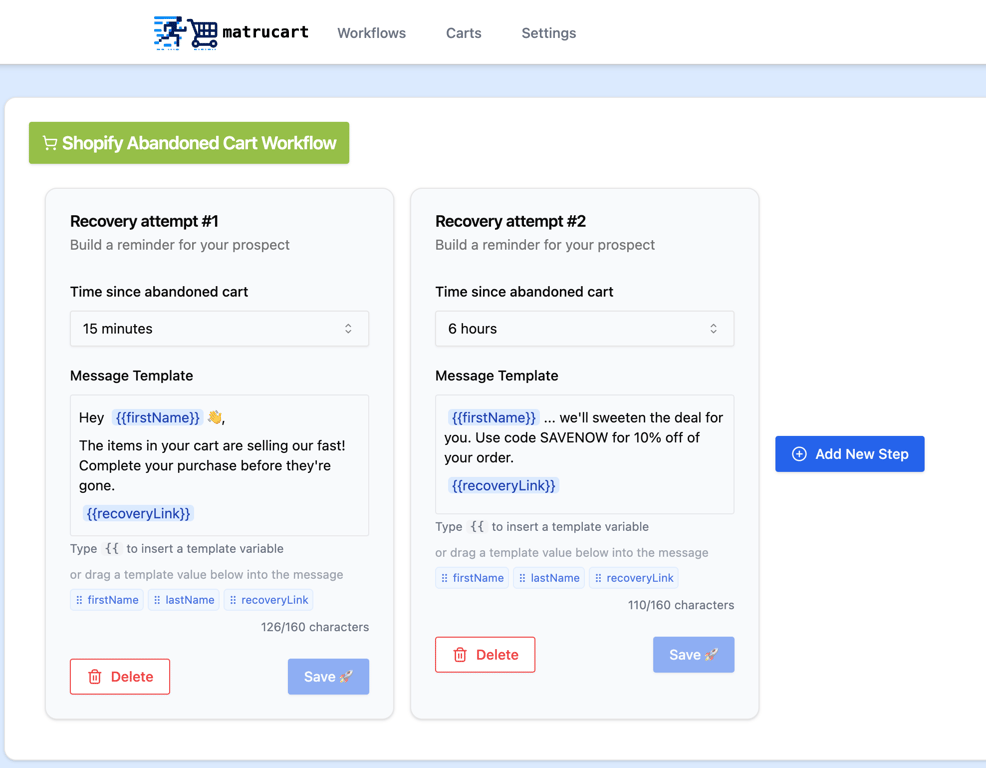
15 Abandoned Cart SMS Templates That Actually Recover Sales
15 ready to use sms templates you can use to start recovering sales for your abandoned carts in Shopify.
Read Full Story
Email vs SMS for Abandoned Cart Recovery: Which is better for your small Shopify store?
Does your Small Shopify store need email or SMS for cart recovery?
Read Full Story
The Real Cost of Abandoned Carts for Small E-commerce Stores
See how much more revenue you could possibly make if you start recovering abandoned carts.
Read Full Story